
A Successful Step Toward Safety and Justice
22 October 2025 marked a transformative moment in family law. Watch here.
Following sustained advocacy by Right to Equality, the government announced they would remove the presumption of parental involvement. This confirmed that a child’s right to safety must always outweigh a parent’s right to contact.
This change represents a decisive shift away from the pro contact culture of the family courts and recognises the lived reality of children and survivor parents navigating unsafe contact arrangements.
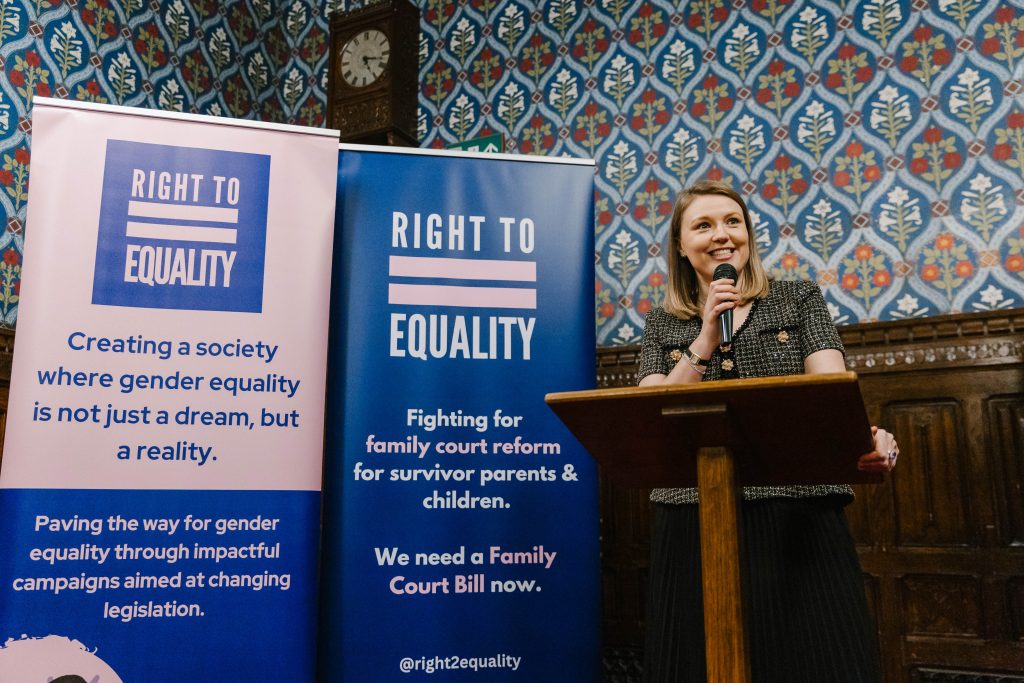
Right to Equality launched a landmark campaign in Parliament on 15 November, hosted by Jess Phillips and Caroline Nokes, calling for the abolition of the presumption of child contact with abusive parents in the family courts.
The campaign was co led by Dr Charlotte Proudman, Founder and Director of Right to Equality, and Adrienne Barnett, Reader in Law at Brunel University London and Adviser to Right to Equality.
The launch brought together legal professionals, domestic abuse experts, survivor advocates, policymakers, and the media to highlight how the presumption of contact enables post separation abuse and places children at serious risk.
Background and legal context
-
The presumption of contact extends to the issue of parental responsibility. Family law reinforces a cultural and legal norm of parental responsibility for both parents, even in cases involving rape and murder by parents, often fathers. This approach fails to adequately consider the safety and well-being of survivors and their children, perpetuating an environment that can place them at risk. Under statute, a married father can never have his parental responsibility removed even if he killed the child’s mother or violently assaulted the child.
-
The Ministry of Justice Harm Report, published in June 2020, identified systemic minimisation of domestic abuse in the family courts and a deeply entrenched pro contact culture. Courts frequently prioritised contact over safety, even in cases involving serious abuse.
-
One of the most common litigation tactics used by abusers is accusations of so-called “parental alienation”. A UN Special Rapporteur report has described parental alienation as a discredited and unscientific pseudo concept aimed at discrediting mothers seeking to protect their children. The Minister for Courts and Legal Services has also stated it is a “totally discredited concept”.
-
BAME women are particularly vulnerable within the family courts due to intersectional inequalities including sexism and racism. Women and children are frequently retraumatised by unsafe contact decisions. Allegations of domestic abuse are routinely minimised. Far too often women, and their children are re-traumatised, re-victimised and failed by the family justice system.
-
The Court of Appeal case of Re A (Parental Responsibility) [2023] EWCA Civ 689
Alexandra Wilks represented the Appellant Mother seeking to curtail the father’s parental responsibility due to domestic abuse. Despite the argument for incompatibility under the Human Rights Act, the court upheld the distinction between parental responsibility for married and unmarried fathers, citing the historical principle. This decision reflects the historical principle of irrevocable parental authority for married fathers, even with a history of domestic abuse.
JH v MF [2020], where survivors’ pleas for protective measures were disregarded, revealing a concerning lack of comprehension about the complex dynamics of domestic abuse. This case highlights the critical necessity to revise existing practices and protect survivors and their children from further harm.
The Court of Appeal case of Re H-N and Others [2021] EWCA Civ 448 also vividly exemplifies this troubling trend wherein the courts appear inclined to prioritise parental contact with the child, even in the face of serious allegations of abuse. The appeals examined within the case involved instances where allegations of domestic abuse were vehemently contested. The court’s guidance on key matters, such as the necessity of fact-finding hearings and acknowledging patterns of coercive behaviour, underscores how the pro-contact culture often overrides the concerns raised by serious abuse allegations.
Our work continues
The abolition of the presumption of parental involvement marks a critical step toward prioritising the safety and wellbeing of children. It ensures decisions are made based on individual circumstances and evidence, not legal assumptions that place children at risk.
While the presumption has been abolished, continued reform is necessary to ensure the family justice system consistently prioritises safety, equality, and evidence based decision making.
Right to Equality is closely following developments until the repeal is made into law.